

A beginner’s guide to LDS music notation
LDS music notation uses the same basic language found in most Western music: a staff, clef, key signature, time signature, notes, rests, and expressive markings. What makes many Latter-day Saint arrangements distinctive is their focus on congregational singing, clear vocal lines, piano accompaniment, and texts designed to support worship.
You do not need to play an instrument fluently to begin reading a hymn or sacred song. A steady approach is more useful than memorizing every symbol at once. Start by identifying the musical map, then work through pitch, rhythm, words, and performance instructions in that order.
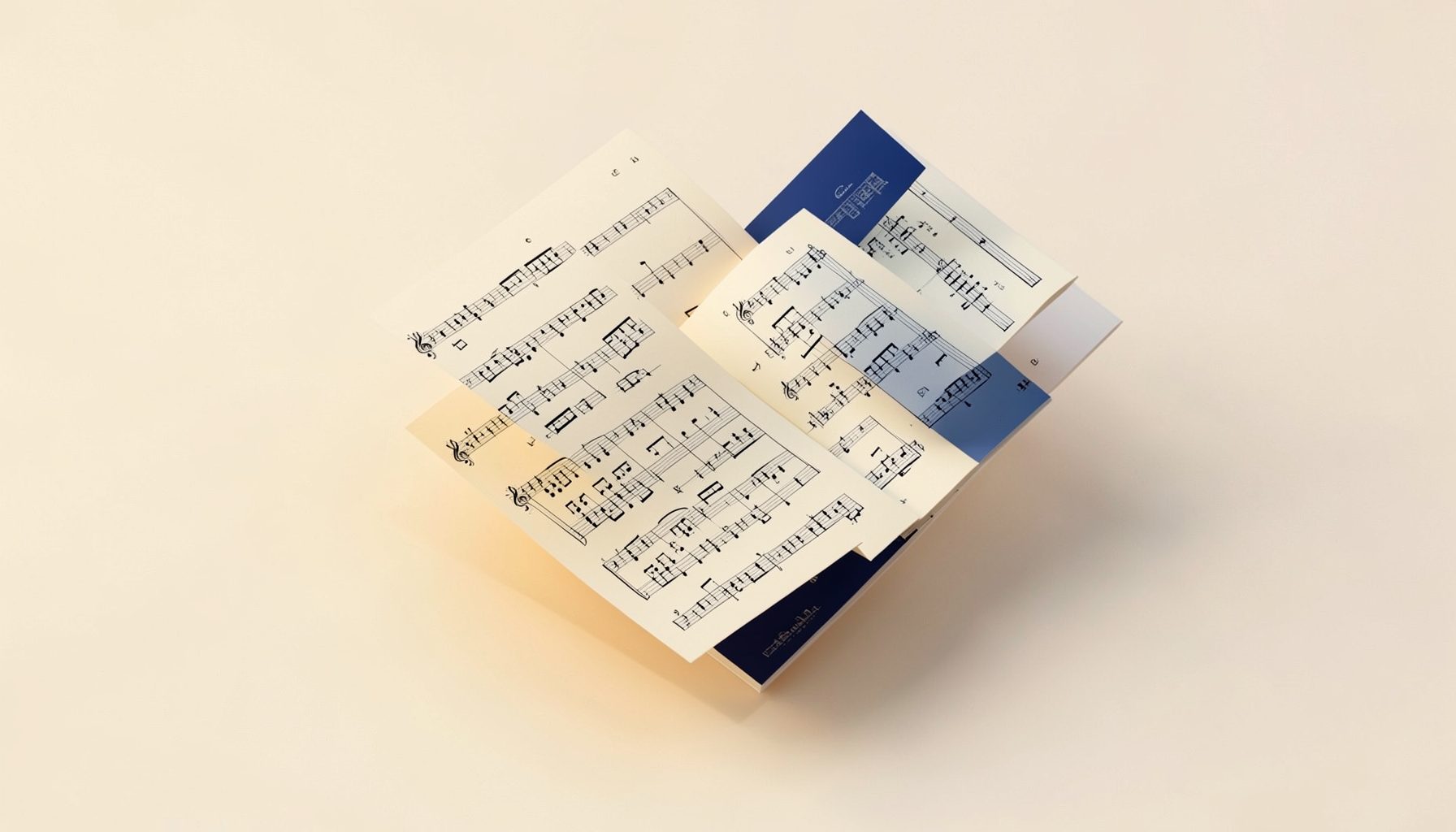
Printed hymn arrangements can look dense because several voices and systems appear together. Once you understand how those layers relate, a page of sheet music becomes a set of practical directions rather than a collection of unfamiliar marks.
Start with the musical map
The staff is a group of five horizontal lines and four spaces. Each position represents a different pitch, and the clef tells you how those positions are named. Most LDS piano music uses a grand staff: a treble clef for the right hand and a bass clef for the left hand. Vocal parts commonly use treble clef, although lower voices may be written in another clef or with an octave indication.
A brace connects the treble and bass staves when they are meant to be played together. Read from left to right, and follow the vertical alignment between the two staves. Notes stacked at the same point in time belong to the same musical moment, even when the hands play different pitches.
The key signature appears after the clef and identifies recurring sharps or flats. It helps establish the song’s tonal center. A separate accidental, such as a sharp, flat, or natural symbol beside a note, changes that pitch for the relevant portion of the measure.
Learn pitch and rhythm together
Pitch tells you how high or low a note sounds, while rhythm tells you when it sounds and how long it lasts. Beginners often focus on note names and overlook timing, but both elements must work together. A correct melody with uneven rhythm will still feel unfamiliar.
The time signature appears near the beginning of the piece. Its upper number indicates how many beats are grouped in each measure, and its lower number identifies the note value receiving one beat. In common time, written as 4/4, four quarter-note beats usually fill each measure. A 3/4 signature commonly creates a three-beat pattern associated with a waltz-like pulse.
Use the first beat of each measure as an anchor. Count slowly, tap the pulse, and speak subdivisions when notes become shorter. A quarter note may receive one beat in common time, while a half note generally receives two and a whole note four. Dots extend a note by half its original value, and ties connect the duration of two notes with the same pitch.
Recognize the parts of a hymn
A hymn page usually combines melody, harmony, lyrics, and accompaniment. The upper vocal line may carry the tune, while soprano, alto, tenor, and bass parts create four-part harmony. In a piano setting, the right hand often doubles or supports the vocal texture, and the left hand supplies bass movement and harmonic foundation.
Lyrics are aligned beneath the melody so that each syllable corresponds to a note or group of notes. A curved slur or an extended underline can show that several notes belong to one syllable. Watch for repeat signs, first and second endings, and text directions such as “verse,” “chorus,” or “refrain.”
The music archive blog can provide useful historical context when you encounter a familiar hymn, artist arrangement, or devotional recording. Listening to a performance may clarify phrasing, but use the printed notation as the primary guide when learning what the composer or arranger actually indicated.
| Mark or feature | What it tells you | Beginner’s action |
|---|---|---|
| Clef | How staff positions are named | Identify the clef before naming notes |
| Key signature | The recurring sharps or flats | Notice which pitches are altered |
| Time signature | How beats are grouped | Count the stated number of beats |
| Bar line | The boundary of a measure | Reset your beat count at each line |
| Slur | Smooth connection or phrasing | Play or sing without unwanted breaks |
| Tie | One sustained pitch across notes | Hold the sound for the combined value |
| Dynamic marking | Relative loudness | Change volume gradually and musically |
Follow expression markings
Notation records more than the notes themselves. Dynamic symbols such as piano and forte indicate softer and louder playing, while crescendo and decrescendo describe a gradual increase or decrease in volume. These markings help shape a sacred song so that it communicates meaning rather than sounding mechanically even.
Articulation marks affect how notes begin and end. A slur generally calls for connected phrasing, while a staccato dot indicates a shorter, separated sound. A tenuto line may suggest that a note should receive its full value or a slight emphasis. Interpret these signs in relation to the text and the musical phrase.
Tempo markings describe speed, sometimes with words such as “Moderately” or “With feeling,” and sometimes with a metronome number. Treat the suggested tempo as a starting point. In congregational music, a comfortable pace that supports clear words is usually more important than playing as quickly as a recording.
Understand chords and accompaniment
Chord symbols appear above a staff in many modern sacred songs and simplified piano arrangements. A symbol such as C identifies a C major chord, while Am indicates A minor. Added numbers, slash chords, and suspended symbols provide more specific instructions, but a beginner can first learn to recognize major, minor, and dominant seventh shapes.
Roman numerals may describe a chord’s function within a key rather than its letter name. In the key of C, I represents C, IV represents F, and V represents G. This system helps musicians transpose a song, compare arrangements, and understand why certain harmonies create rest or tension.
A lead sheet may show only the melody, lyrics, and chord symbols. A full piano score gives more precise information about voicing, rhythm, and accompaniment patterns. Neither format is automatically better: the appropriate choice depends on whether you are accompanying a congregation, practicing a vocal part, or creating a personal arrangement.
Compare notation formats before practicing
LDS music collections may include hymnbook pages, piano solos, vocal arrangements, lead sheets, and digital recordings. Each format demands a slightly different reading strategy. A solo piano score requires attention to both hands, while a lead sheet asks the performer to interpret the chord symbols and create an accompaniment.
Release notes and catalog coverage, such as this overview of recent LDS releases, can also help you identify whether a piece is a recording, a printed arrangement, or a broader collection. Knowing the format prevents you from expecting a simplified chord chart to provide the same detail as a fully engraved score.
When choosing beginner material, look for a clear melody, a manageable key, and a tempo that leaves room for counting. A familiar hymn can be an excellent first piece because you already know how the tune should sound, allowing you to concentrate on reading symbols.
Build a reliable practice routine
Begin with a silent scan of the page. Identify the clef, key signature, time signature, repeats, and any tempo or dynamic directions. Then clap or tap the rhythm before playing pitches. This separates timing problems from note-reading problems and makes the first attempt less frustrating.
Practice one phrase at a time rather than restarting whenever a mistake occurs. Speak note names, count aloud, or play the melody alone before adding harmony. If you sing, use a comfortable starting pitch and keep the text clear. If you accompany others, prioritize a steady pulse and supportive volume.
Use these habits as a simple starting routine:
- Read the key and time signatures before touching the instrument.
- Mark difficult notes or rhythms lightly in pencil.
- Practice each hand or vocal phrase separately when necessary.
- Listen for balanced melody, harmony, and text instead of volume alone.
- Review one previously learned phrase at the end of every session.
Music notation becomes familiar through repeated, attentive contact. After several short sessions, you will begin to recognize common intervals, chord patterns, cadence shapes, and rhythmic groups without calculating each symbol individually.
Choose one accessible hymn or sacred song, find a clearly printed arrangement, and work through its first phrase today. Trace every marking, count each measure, and then perform the phrase slowly with its words and dynamics. That small, complete reading builds the foundation for exploring more LDS sheet music with confidence.